
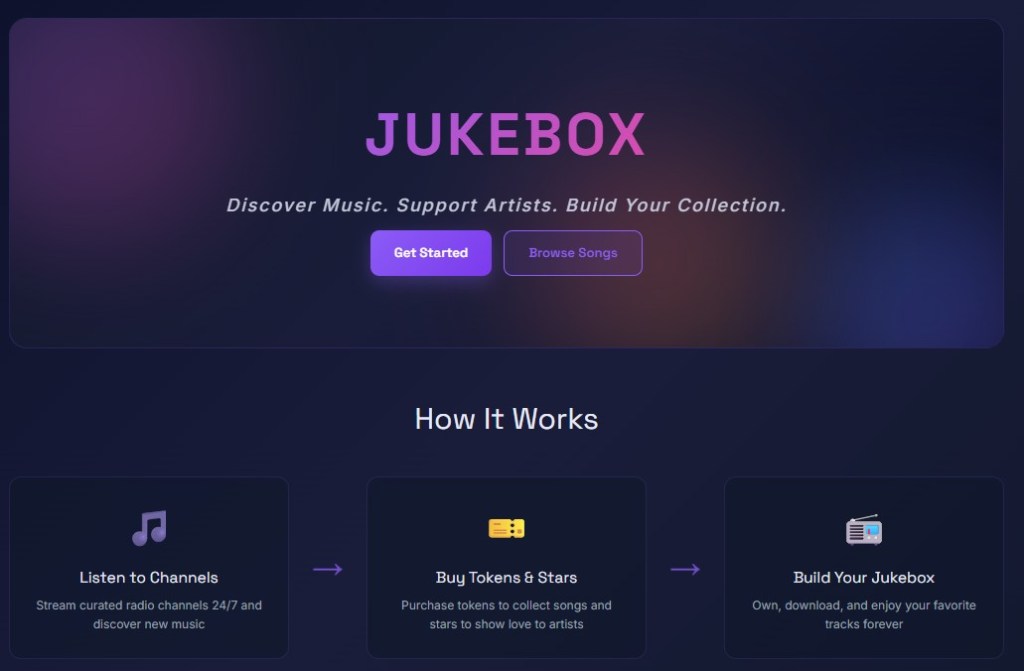
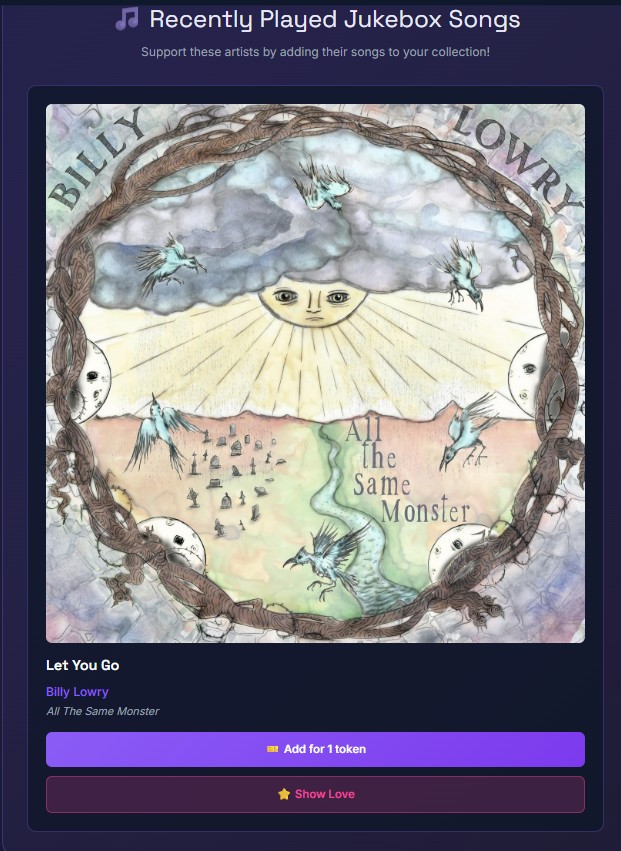
We’ve made some great progress with Jukebox, there’s still a lot of testing happening in a live environment and bugs being worked out that pop up day to day. We have a build, a website, and mobile website going. The next phase is creating a mobile app that if I had to try and put a timeline on it, will be (fingers crossed) somewhere in the late Spring / Summer of 2026.
Here are some quick highlights and then I’ll get to the meat and potatoes of it.
- Over 7000 lines of code is what it took to bring the concept to this point
- Listeners are welcome to create an account, tune in, and build a collection. It’s free
- Artists are welcome to create an account, tune in, and build a collection. It’s free and you earn royalties (more on that below)
If you happen to be reading this, you are what I would think of as an “early adopter,” and hopefully you would be interested enough in helping build a community and being part of molding something sustainable. When I first pitched this idea to my good friends Marc Schuster and Brian Lambert a couple years ago, and then more recently to my friend Bigbaldben last year around this time, there were a lot of “big ideas” that got added to the core idea that would be awesome to implement at some point in the future. However, I did eventually have to come to a realization that between my time, money, and flat out expertize (I am not a “dev” by any stretch of the imagination) – holding my breath to fully implement all the great ideas that came up in those conversations would also likely mean never getting the idea off the ground. In short, I’m not looking to take over the world with this. I’m not looking to be the “Bandcamp alternative.” Or “replace Spotify.” All of which are topics I’ve seen floating around online but make no mistake about it, I’m on board with and in full support of. That’s just not what is within my means to do with Jukebox, nor do I feel like I am going for the same “target audience” as what some of those other ongoing efforts are going for.
Why Jukebox? For listeners
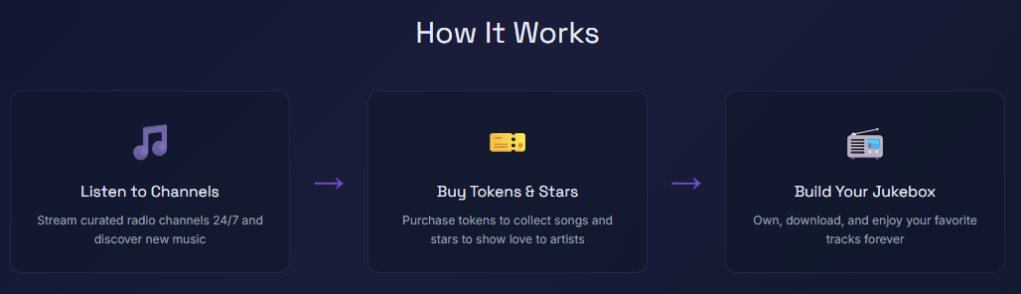
The target audience when it comes to being a listener is someone who I think would find value in these things.
- Someone who cares enough to want to support indepedent underground music
- Someone who is inquizitive and has an interest in finding new music regardless of it’s position in the mainstream
- Someone who sees value in a non-subscription based business model. Or can’t afford to take on another subscription bill. Let’s face it, today we are creating apps just to remind us what subscriptions we already have to find ways to save money. Jukebox is consumer friendly, pay as you go, and no matter what, whether you buy tokens or not, you always have access for music for free on the radio station, no strings attached.
- Someone who sees value in a traditional, human curated catalog. Whether the average listener realizes it or not, most if not all content presented to them via streaming services (that “one” in particular) is curated by corporately sponsored algorithms. And as of most recently, a good portion of that algorithm is dominated by generative AI music
- Someone who shares a nostalgia for what it was like discovering and sharing music before the “streaming era.” We used to listen to music on the radio anxiously, waiting to hear that song we loved, and have our cassette decks ready to hit record when it came on. This is why we call our playlists in Jukebox “mixed tapes.”
Why Jukebox? For artists
The landscape of independent artists these days is just as diverse as that of listeners. I think for artists who have been navigating the waters of the current day music industry can appreciate some of these features
- 3 ways to monetize
- Online radio play: AMS Radio is a licensed online radio station through Live365. This is the tradional way of earning royalties.
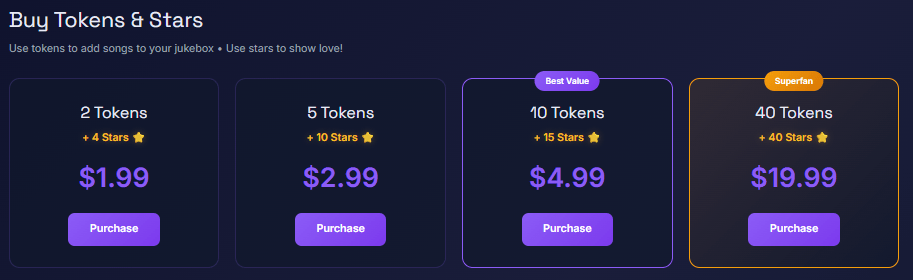
- Selling songs for tokens. If a listener spends a token to purchase your song it goes into their Jukebox, the artist earns the token, and can cash in their tokens for money once they earn a minimum of $2.50
- Earn money for “likes.” If a listener “shows love” by giving an artist’s song a “star,” it does a couple things. For the listener, it goes to their “loved songs” in Jukebox so they can buy it with a token later (only 30 second previews of the song available until purchased with a token). An artist can cash in stars too, it supplements the tokens they earn.
- No fees. We take on the fees on behalf of the artist. If you cash out $2.50, you get $2.50
- There is nothing to lose. Artists are in control the whole time, to add and remove songs as they please. An artist can submit for radio play without opting into Jukebox if preferred. Opting into Jukebox only supplements the traditional way of earning online radio royalties
- Drive traffic and use as a promotional tool. Each artist profile has a limit of 15 songs they can opt in for Jukebox. The intention behind this is to encourage an artist to rotate songs from their catalog in and out of radio play to keep content on the station fresh and new. Each artist has a profile with a “find me here link” for fans that may want to dive deeper into an artist’s full catalog (be that at their website, a preferred streaming service, link tree etc.)
Devil in the details – radio royalties
Online radio royalties are collected through your country’s performance rights organization (PRO) and through Soundexchange.
For artists in the US, Canada, Mexico,and UK: These are the areas Live365’s licensing covers. You will want to ensure your songs are registered with your country’s PRO (in the US that’s BMI, ASCAP, SEASAC, etc.) and also register with SoundExchange.
For artists outside of the US, Canada, Mexico, and UK: You will want to ensure your that country’s PRO has arrangements with PROs in either the US, Canada, Mexico, or UK to collect. In all scenarios, an artist is going to also want to register with SoundExchange and claim their ISRCs.
Devil in the details – tokens
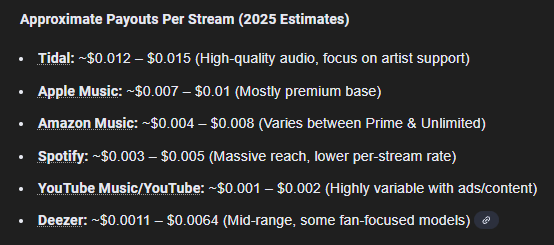
I’ll go ahead and say upfront that Jukebox is optional. If you have some sort of great momentum going on where your downloads are selling like hot cakes, and/or your repeat streams are providing you a sustainable living, then Jukebox might not be for you, and that’s ok and that’s awesome for you. For the rest of us, an artist can cash in tokens earned and each are worth 25 cents. Why 25 cents? Because it’s a primary objective to provide listeners a good deal on music they haven’t heard yet, might never hear given the reasons I laid out before, and build a collection. After bank fees (which does not get passed on to the artist) this was the most equitable figure I could come up with to keep up with overhead cost and give the artists a fair and transparent portion of the margin. No cost to artists to particpate, no hidden fees, and artists need at least $2.50 to cash out. Check out the latest streaming rates, this still works out to be 600-1200% more than what an artist would earn from a stream and get paid from a distributor 3-6 months down the road.
Devil in the details – Stars and “showing love”
The earnings for a star collected is higher than the “high end” stream rate on Spotify of $0.005. A star on Jukebox is a full penny. When a listener “shows love” by giving an artist’s song a star, the big idea is so that a listener doesn’t lose track of a song they are potentially interested in. It’s a “known” thing in the radio industry that listeners tend to respond better to a song after repetition. “Loved Songs” act as bookmark for a listener that might not have tokens to spend at the time, plan to get more tokens later, or would just simply like to priortize what of their “loved songs” they would like to spend tokens on first.




 Audio Mirage Studios
Leave a reply to New Channel and Listener Rewards Program – Audio Mirage Studios Cancel reply